Tips and Applications

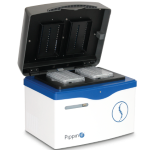
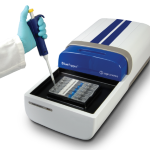
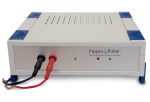
Pippin Pulse

Field Inversion Gel Electrophoresis

Pulse for webstore


We’ve set up this post to provide Pippin Pulse users with a resource to keep updated on new protocols and to post references that might be useful. We also invite users to feel use this page as a forum, if you see fit, and we’d enjoy showing interesting gel images and data (email these to support@sagescience.com).

Our go-to book on theory:
“Electrophoresis of Large DNA Molecules:Theory and Applications” (E. Lai and B. Birren, eds), Current Communication in Cell & Molecular Biology Vol. 1,. Cold Spring Harbor Laboratory Press, New York, 1990

Here’s nice overview on pulsed field techniques:
Pulsed Field Electrophoresis for Separation of Large DNA

Download the Pippin Pulse user manual here

Our Gel Set-up
We use a Galileo Model 1214 RapidCastTM Mini Gel Unit running 12 X 14 cm gels using Lonza SeaKem® Gold Agarose. We use our Pippin Tris-TAPS buffers (which you can order directly from us in the US and Canada, Part No. KBB1001, under “Accessories” on our ordering page) or 0.5X TBE. The formulations can be found in the Pippin Pulse user manual or separately here.

Gel images of our 1-50kb and 3-70kb protocols:
(click to enlarge images)
150 gel blog370 gel for post

Posted in Blog, Tips | Leave a comment

Pippin Platform Recommended for Nextera Mate Pair Size Selection

Illumina released new sample prep protocol guidelines for generating mate pair libraries with its Nextera kit, and we’re pleased to report that the Pippin platform is the recommended choice for automated size selection.

You can check out the Nextera Mate Pair Sample Preparation Guide here . (We’re under Size Selection in Chapter 3, beginning on page 40 of the Guide.)

Illumina says that using an extra size selection step offers “more stringent” sizing than AMPure alone and lets users make libraries with larger fragments and more precise distribution than a gel-free approach. While the company has validated a manual approach in addition to the Pippin platform, Illumina’s guidelines note that “in our experience running a standard agarose gel does not provide as robust and reproducible results as the Sage Pippin Prep.”

In the user document, Illumina recommends the Pippin Prep with the 0.75% cassette and “eluting fragments with a broad range of sizes, of 3 to 6 kb in width, increasing in width with increasing fragment length (e.g. 2–5 kb, 4–8 kb or 6–12 kb).”

For current Pippin users, we would like to add that you can also use the 0.75% agarose dye-free cassette (BLF7510) with the BluePippin for equivalent results.

Posted in Blog, Tips, Uncategorized | Leave a comment

And Now, a Word from Our Customer Service Department

Here at Sage Science, we are delighted to see more and more people signing up as customers of the Pippin platform. With so many instruments out in the wild, we thought it would be a good time to sit down with our customer service department (aka the incomparable Sadaf Hoda) to find out which topics are asked about most often, and what advice we can offer. Here’s what we came up with:

Q: My instrument came with a calibration fixture. What do I do with it?

A: It’s important to perform a simple LED calibration before each run of the Pippin instrument. This only takes 5 seconds and will give a pass/fail report letting you know that the LEDs are calibrated properly to optimize your run. When doing the calibration, be sure to center the fixture over the LED lights with the sticker facing up and the filter side facing down.

Q: The lid won’t close. Is something wrong with the instrument?

A: If you haven’t removed the tape strips from the buffer chambers on the cassette, that will prevent the electrodes from sitting down in the wells properly. Just take the tape strips off, and the lid should close fully.

Q: I stored the reagents and the cassettes separately, and now I can’t tell which reagents go with which cassettes. Help!

A: It’s very important to use the specific DNA marker or internal standard that is packaged with the cassette packages. We recommend that you store the cassettes at room temperature, and the reagents at 4oC. The labels on foil bags containing the cassette indicate which marker to use, as dp the cassette definitions in the software. For comprehensive information on cassettes go to our support page (www.sagescience.com/support) and download the Cassette Reference Chart for either the Pippin Prep or BluePippin. These are found in the “Guides” section.

Q: Are there different sample prep procedures for different cassettes?

A: The sample prep for cassettes is the same on the Pippin Prep and the BluePippin, but there are different protocols for cassettes with internal standards and ones with external markers. For internal standards, you will fill all five lanes with 40 microliters of sample (30 plus 10 microliters of standard/loading solution mix). For cassettes using external markers, you’ll fill one lane with 40 microliters of marker and the other four lanes with 40 microliters of sample (30 plus 10 microliters of loading solution).

Q: I’m using Illumina TruSeq kits. Does that have an effect on my size selection?

A: Yes, it’s been established that Illumina’s TruSeq kits require an offset for any size selection method, from manual gel excision to automated solutions like Pippin. Our experience with customers is that the offset is usually 100 to 150 base pairs if adaptor-ligated DNA is being run. The Illumina’s TruSeq user manual also provides guidelines about the offset to incorporate.

Q: I’ve finished my run. Now what?

A: We recommend that you immediately remove the cassette, and leave the lid open. If you leave the lid closed with the cassette still in the instrument, over time, salt can build up on the electrodes and lead to inaccurate sizing in one of the cassette lanes. This problem can be avoided by removing the cassette promptly and leaving the instrument lid open between runs.

Do you have a question that you feel should be answered here? Leave a reply, and we’ll post it!

Posted in Tips | 5 Comments

Band Capture with Midori Green on the BluePippin

Our band capture cassettes, for use on the BluePippin, are designed to automatically collect a band or fragment of DNA from a sample and remove unwanted DNA and/or primer artifacts. We’ve provided users with some flexibility to manipulate the capture parameters, outlined below. Unlike the ethidium-containing cassettes used on the Pippin Prep, we require users to add a DNA binding dye, Midori Green, prior to use so that the system can detect your sample DNA. Band Capture cassettes part numbers are BLG7510 for 2 kb – 10 kb bands, and BDG1510 for 250 bp – 1.5 kb bands.

What is Midori Green?
Midori Green is a safer alternative to ethidium bromide that was developed by Nippon Genetics Europe, GmbH. Its fluorescent properties are easily detected by the BluePippin’s fluorescein-compatible optics.

You can read about Midori Green here, it’s a great product.

How to use band capture cassettes
Midori Green will lose its intensity with prolonged storage at room temperature, so we ask users to store at 4oC and add it to our cassettes just prior to use. A small amount is added to the opposite end of the gel cassette (like ethidium, it electrophoreses in the opposite direction of DNA). In software, users enter a software base pair threshold value, somewhere between 80% and 90% of the anticipated band size. The system will collect the very next band it detects after that threshold has passed.

We also provide some simple tools to help users tweak their collections in the form of “expansion factors” . In the software protocols, these parameters are labeled “Start Exp” and “End Exp.”, and they are used to determine how close (or far away from) the DNA band the collection occurs. In “tight” mode collections of sheared DNA, the Pippin collects the narrowest distribution possible. The timing of these collections (“BP Start” and “BP End”) are uses as guidelines to determine the timing of band capture. This figure below shows the position of the collection timing, and where we’ve set the default “expansion factor” settings. We’ve widened the gap by increasing the base pair values by 10% on either end.

The figure below shows the parameters fields in a BluePippin protocol for a 10 kb band collection (band capture cassettes use “peak” mode). The “Start Exp” and “End Exp” values may be programmed to move the arrows in the figure above accordingly.

Sample loads over 5 ug/band will likely need protocol adjustments
The default settings should be fine for sample loads that are 5ug/band and below. Since higher loads have a higher DNA-to-dye ratio, they run faster, and the bands are typically broader. We rarely see the need to change the “Start Exp” value, but the “End Exp” typically requires a boost – we find that 1.50 ”End Exp” value will collect the widest band we’ve tested, but some method development may be required:. This figure illustrates the type of band broadening that occurs at higher sample loads.

Posted in Applications, Blog, Tips, Uncategorized | Leave a comment

BluePippin “Mid-Range” Size Selection: 18-27 kb

We’re pleased to be shipping our Mid-Range size selection cassette (BMF7510) for the BluePippin. While our Low-Range cassette (BLF7510, 1kb-10kb) works for many mate-pair library construction protocols, we’ve been hearing from our customers that there is interest in creating larger circularized molecules. This cassette, which continues to extend the range and flexibility of the BluePippin product line, should serve as a useful tool for large-fragment preps and help produce more diverse and meaningful data.

(Some internally generated validation data can be found on this pdf.)

In this blog, we’d like to outline some characteristics on the product to help users develop appropriate methods.

CVs and target ranges
We define all target ranges in terms of what a user can accurately collect by entering a value in “tight” mode using our software. We also have a specification, “Minimum Size Distribution as Expressed by CV,” that describes the minimum distribution of fragments that may be collected given the capabilities of the system and the resolution of the gel. For instance, as a rule of thumb, a CV of 8% (our spec for smaller targets) will yield a range of fragments that are at most + 16% of the median fragment. However, the mid-range targets collect at a comparatively larger distribution minimum (20% CV), which limits the effective range of accurate “tight” cuts. This chart compares the accurately selectable “tight mode” ranges to the “range mode” ranges for the gel cassette calibrations available for the BluePippin at this time:

Sample Load Dependence
To calibrate the mid-range cassettes, we use a 5 ug sample load of sheared E. coli genomic DNA. Higher sample loads (up to 10ug) will usually run somewhat slower, relative to the marker DNA, and for this reason, you will need to program higher bp target or range values in the protocol to collect a desired size fraction. In our tests, when using a 10 ug input load, bp target values should be increased by 10-15% to compensate for the changes in mobility caused by the increased load.

Another factor to consider is the size distribution of the input DNA. For calibration and testing, we use an E. coli genomic DNA sample that has a very broad, almost flat size distribution. Using such samples simplifies our calibration process, which involves accurately sizing fractions sliced from the flat input samples. However, most input samples for mate-pair libraries are generated by methods that produce much narrower size distribution (DigiLab Hydroshear, for instance). Such samples will therefore show a different mobility dependence on input load than our E. coli genomic DNA test samples. For this reason, customers should plan on conducting some pilot experiments on non-valuable samples to investigate the mobility-load relationship produced by their specific library protocol.

Bottom line on 0.75% Mid-range cassette definition

  1. BluePippin 0.75% mid-range cassettes facilitate size fractionations of DNA samples out to 30kb.
  2. The CVs of tight size selections will be wider than those obtained from other BluePippin and Pippin Prep cassettes (mid-range CVs around 20%).
  3. The mid-range protocols show a significant mobility dependence on input load. Sage uses a 5 ug genomic sample with a broad size distribution for calibration. Higher input loads and samples with narrow size distributions will require user optimization of programmed size values for accurate results.
  4. Input loads higher than 10 ug per lane will have unpredictable results, and are not recommended.

If you plan to use the the BluePippin for mate-pair library construction, we’d love to hear of your progress or suggestions. To share, please contact us at info@sagescience.com or reply to this blog.

The image below is an Agilent Bioanalyzer trace of a nice 8 kb collection in the middle of a gDNA shear. This is near the limit of the Bioanalyzer’s detection target range.

Posted in Blog, Tips, Uncategorized | Leave a comment
Page 1 of 212